Central Park:
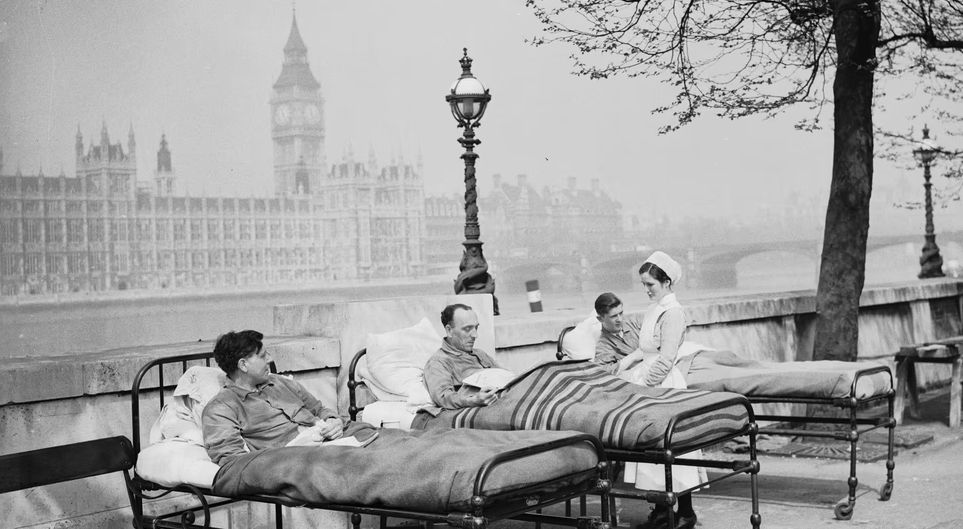
New York City’s central park was created in large part as a respite from an outbreak of tuberculosis sweeping the city in mid and late 19th century. Similarly a desire for fresh-air and sunlight drove city planning guides and architectural designs resulting in New York’s typical “H” and “E” plan apartment blocks.
Haussman’s Paris:
Paris, under the rule of Napoleon III and the energy of Georges-Eugène Haussman, famously addressed the growing unsanitary conditions and congestion in the French Capital by cutting eighty kilometres of new avenues through the heart of the city. (Haussman’s project reportedly employed 1/5th of Paris, displaced hundreds of thousands of people and lasted 17 years.)
Hospital Design
https://www.architectural-review.com/essays/typology/typology-hospitals/8629443.article
The origins of the hospital as a type are far from the city, but the typology of the city has played a large part in shaping the modern hospital. Paradoxically, from the middle of the last century the design of city hospitals has generally ignored the urban fabric in which they are set, making only the minimum essential logistical connections. Now with advance in the understanding of environments for healing and a greater appreciation of the role and value of networks of urban public space, architects and co-designers need to rediscover and re-cast the typology of hospitals and healthcare settings generally to enact a potent integration with the city.
The architectural genealogy of hospitals starts in the ancient world. The temples of Askelpios in Epidaurus and Kos in Greece (around 500BC), where the sick came to be diagnosed and healed, placed faith in the power of sacred settings and ritual. Ancient Roman hospitals on the other hand were developed for military purposes with plans based on barracks. These two traditions – the military and the religious – are consistent threads in the development of hospitals right up to the 20th century. They have parallels today in the sometimes competing, and sometimes complementary, ideas of a hospital as an efficient mechanism for delivering treatment and a hospital as a place for healing.
Quarantine
Quarantine
- Geoff Manaugh’s work on Quarantine
- Ship of fools – Foucault
At a smaller scale the evolution of Hospital design reflects similar attitudes towards separation, distancing and quarantine.
https://www.curbed.com/2020/3/17/21178962/design-pandemics-coronavirus-quarantine
https://camd.northeastern.edu/news/sara-jensen-carr-disease-public-space/
https://ajph.aphapublications.org/doi/pdf/10.2105/AJPH.83.5.758